Related stories
• About the Dick Enberg Award
• Past Dick Enberg Award recipients
CSC selects Billy Mills as 2026 Dick Enberg Award recipient
Billy Mills, humanitarian and co-founder of Running Strong for American Indian Youth, U.S. Olympic Champion & Hall of Famer, and three-time All-American cross country runner at the University of Kansas, is the 2026 College Sports Communicators (CSC) Dick Enberg Award winner. Mills will be in attendance at the CSC Unite 2026 convention to accept his award during the June 8th CSC All-Star Night of Honors, presented by ESPN.
by Blake Timm, College Sports Communicators Special Awards Committee Vice Chair
“(Dick Enberg) is a legend. I am honored and humbled by this award. My dad would tell me to take my culture, traditions, spirituality, and put them together, extract the virtues and values that empower them, and put those virtues and values into your daily life. And that’s basically what I’ve done to try to understand the diversity of the world.”
- Billy Mills, Running Strong for American Indian Youth National Spokesperson/Olympic Champion and Hall of Famer
In the 62 years since completing one of the greatest upsets in Olympic track and field history, Billy Mills has dedicated himself to global unity.
Whether through his service in the U.S. Marine Corps, through his platform as an Olympic gold medalist, or in his dedication to improving life for his Native American brothers and sisters through the foundation he co-founded, Mills has worked tirelessly to make the world a better place.
“The opportunity to put people together, that actually began when I was a little boy,” said Mills, a member of the Oglala Lakota Nation who is also known by the Lakota name Tamokoce Te’Hila (Loves His Country, or more traditionally, Respects The Earth). “I heard what Chief Sitting Bull said when he surrendered. He said, ‘Let’s take the best of both worlds and build a new world for our children.’”
In recognition of his dedication and service to the cause of global unity, Mills has been named the recipient of College Sports Communicators’ 2026 Dick Enberg Award. He will receive the award during the CSC’s All-Star Night of Honors at the CSC Unite 26 Convention on Monday, June 8, in Las Vegas.
Named in honor of the longtime sports broadcaster and advocate for CSC’s Academic All-American program, the Dick Enberg Award is presented annually to an individual who has distinguished themselves nationally through their career achievement and meaningful contributions to society while promoting the values of education and academics.
“On behalf of CSC, we are proud to congratulate Billy Mills on being selected as 2026 the recipient of the Dick Enberg Award,” said CSC Executive Director Jason Yaman. “While his remarkable Olympic achievements are forever etched in American sports history, his impact extends far beyond the track. Through decades of leadership, advocacy, and service, he has inspired countless people by using sport as a platform for hope, perseverance, and opportunity. We are honored to recognize Billy Mills and celebrate all he has accomplished.”
 In 1984, Billy Mills joined with Eugene Krizek to co-found the nonprofit Running Strong for American Indian Youth, dedicated to helping Native Americans fulfill their basic needs.
While Mills only met the award’s namesake a couple of times in group settings, he is touched to receive an award honoring Enberg’s dedication to education.
“He is a legend. I am honored and humbled by this award,” Mills said.
Mills was an unknown on the international running scene when he qualified for the 1964 Olympic Games in both the 10,000 meters and the marathon, despite his credentials as a three-time cross country All-American at the University of Kansas and the top American finisher at the 1960 NCAA Division I Cross Country Championships. (Mills finished fifth. The top four finishers were foreign athletes, led by 1956 Olympic 10,000-meter bronze medalist Al Lawrence of Australia.)
Dueling against Australian world-record holder Ron Clarke and Tunisia’s Mohammed Gammoudi, Mills surged in the final 200 meters of the race, passing both competitors in lane four of the final straightaway to win gold in an Olympic record time of 28:24.4, a nearly 50-second personal best.
Mills remains the only Olympic champion in the event from the Western Hemisphere, and the magnitude of the effort has stood the test of time. Runner’s World selected Mills’ triumph as one of its “Four Greatest Races In The History Of The Olympics” in 2000. Four years later, the magazine called it the second greatest moment in Olympic history, behind Emil Zatopek’s triple gold medal in the 5,000 and 10,000 meters and the marathon at the 1952 Games.
Following the Olympics, Mills went on to set the U.S. outdoor record at 10,000 meters, U.S. records indoors at three miles and 3,000 meters, and the outdoor six-mile American and world records before retiring from international track and field competition following the 1965 season.
It was not the race itself that ignited Mills’ quest to pursue and educate others in the values of global unity, but rather two moments surrounding it.
The first came during Tokyo’s opening ceremonies. Hosting the Olympics just 19 years after the U.S. dropped atomic bombs on Hiroshima and Nagasaki to end World War II, the Olympic cauldron was lit by Sakai Yoshinori, born in Hiroshima the day it was annihilated. Mills, then a lieutenant in the U.S. Marine Corps, was touched.
“[The Japanese people] wanted the children born on the day of the first atomic bomb being dropped to participate in the opening ceremonies of the Olympic Games, to see the world as one,” Mills recalled. “That is when [Mills’ wife] Pat and I started forming our journey of global unity through the dignity, character, and the beauty of global diversity. It’s not only the theme of the Olympics, but to me, the future of humankind.”
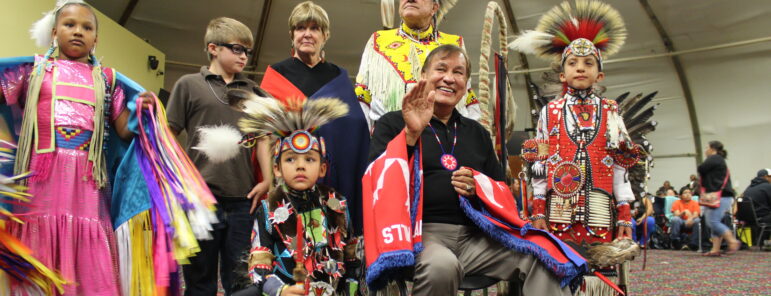 Billy Mills and his wife Pat with children.
The second moment came just before the 10,000-meter final. Diagnosed as pre-diabetic and with hypoglycemia in the months leading up to Tokyo, Mills was in danger of a sugar crash in the minutes before the start. When the U.S. trainers would not help him, a Japanese official did.
“Learning English, he goes, ‘Me, me bar, me get bar.’ He goes up and comes back with a candy bar,” Mills said. “I went low [blood sugar] in the last lap of that race, and that candy bar saved me.”
Years later, Gammoudi, who finished second in the race, told Mills that he was happy that the American had won, a moment that Mills considers a personal step in global unity between himself, a Christian, and Gammoudi, a follower of Islam.
“I said, ‘Mohammed, how could you be happy? I beat you,’” Mills recalled. “He said, ‘No, you didn’t beat me. You won. Anybody who won in the manner you did had to be…” and in silence, he raised his palms and looked skyward. I took this to be a spiritual gift.
“I asked, ‘Mohammed, are you telling me that my victory was a gift to me from Allah?’ He said, ‘Yes, yes, yes.” And looking me in the eyes, he said, “and in your world, a gift from Indigenous spirituality and God.”
 Billy Mills stunned the world when he won the 10,000 meter at the 1964 Tokyo Olympic Games.
After the Olympics, Mills focused on the Lakota value of the giveaway, to give back the power of a dream. He challenges people to follow their dream, leading them to a positive passion in life. “You develop your skills to equal your passion. You bring them together and magical things can happen,” he said.
Mills’ giveaway has included motivational speaking to inspire others to live in unity, and giving back in multiple ways to sports, to his Native American family, and to the members of the Oglala Lakota Nation.
In 1984, Mills joined with Eugene Krizek to co-found the nonprofit Running Strong for American Indian Youth, dedicated to helping Native Americans fulfill their basic needs — food, water and shelter — while also helping their communities gain self-sufficiency and self-esteem. According to its website, Running Strong has reached nearly 80 tribal communities.
In 2015, Running Strong launched its Dreamstarter program in celebration of the 50th anniversary of Mills’ gold-medal run. Ten Native youth each year receive grant funding and mentorship to implement projects of meaningful change. To date, Running Strong has invested over $7.3 million into those projects.
Mills presented the example of a young woman who is Cheyenne River Sioux and Lakota, and wanted to pursue a career in dentistry. “She wanted to try and recruit other Native Americans into dentistry. She got one of the grants, and now she has helped over 30 Native Americans become dentists,” Mills said. “It just goes on and on with our Dreamstarter program. That’s great change.”
The work that Mills has aspired to, he believes, aligns perfectly with the ideals that the Olympic movement aspires to.
“The global unity through the Olympic Games became the core that I used,” Mills said. “I compared them with the virtues and values of the Lakota, centered around our prayer, ‘We are all related,’ and to the virtues and values of our democratic government, one nation under God, indivisible, with liberty and justice for all.”
Mills’ long list of awards recognizes not only his gold-medal moment, but a lifetime of work towards global unity. His five halls of fame include induction into the U.S. Olympic Hall of Fame in 1984.
Mills was presented with the Presidential Citizens Medal by President Barack Obama in 2012. He received the NCAA’s Theodore Roosevelt Award, recognizing a former varsity athlete who has become a distinguished citizen, in 2013.
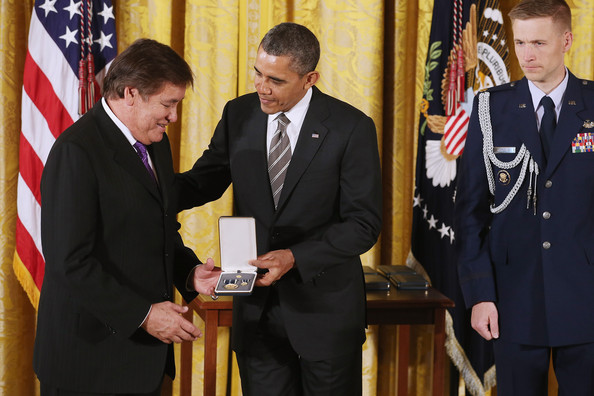 Billy Mills received the Presidential Citizens Medal from President Obama in 2012.
In 2014, Mills received one of his most cherished honors, the Kay Family Award from the Anti-Defamation League, presented to individuals who have demonstrated extraordinary courage in standing up to hatred, antisemitism, injustice, and bias.
As he adds CSC’s Dick Enberg Award to his long list of honors, Mills believes that he has simply lived the way that his Lakota ancestors and elders wanted him to live — pursuing the vision that we can, and should, live in a world of harmony and mutual respect.
“My dad would tell me to take my culture, traditions, spirituality, and put them together, extract the virtues and values that empower them, and put those virtues and values into your daily life,” Mills said. “And that’s basically what I’ve done to try to understand the diversity of the world.”
The CSC Unite Convention is held each year in conjunction with the annual National Association of Collegiate Directors of Athletics (NACDA) and Affiliates Convention. This year’s convention will be held June 7-10 at the Mandalay Bay Resort in Las Vegas. All CSC Unite 2026 convention attendees can attend the CSC All-Star Night of Honors, presented by ESPN, on Monday, June 8 with their convention badge. Those without a #CSCUnite26 convention badge may purchase tickets to the event at CSCommunicators.com/tickets.
About the Dick Enberg Award
The Dick Enberg Award is recognized as one of the most prestigious honors College Sports Communicators may confer on an individual. The award was created in 1997 in recognition of Dick’s passion and support of the Academic All-America® program for more than 30 years and his dedication to education for more than four decades. He served as the official spokesperson for the Academic All-America® program from 1986 until his passing in 2017. The award is presented each year as part of the Academic All-America® Hall of Fame induction ceremony during the CSC Convention.
The Dick Enberg Award is presented annually to an individual who has distinguished themselves nationally through their career achievement and meaningful contributions to society while promoting the values of education and academics.
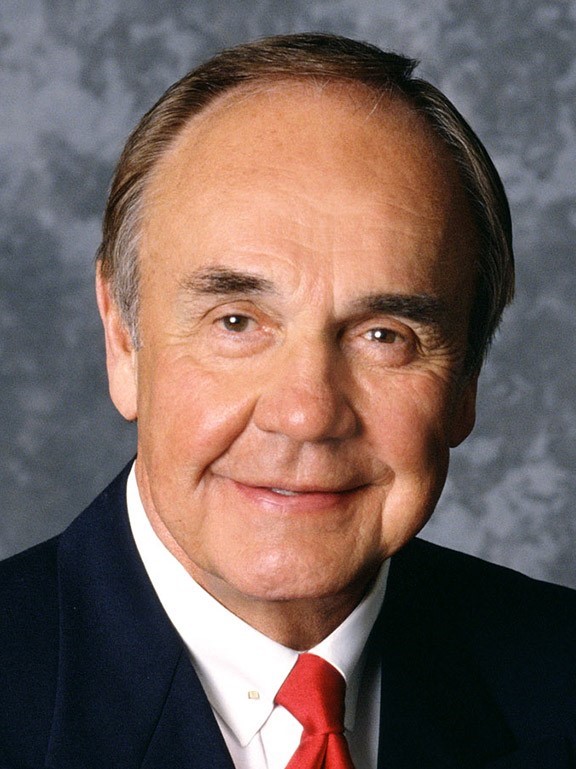 Dick Enberg
Previous Dick Enberg Award Recipients
Dick Enberg
Previous Dick Enberg Award Recipients
2025 Ruth Riley Hunter, Notre Dame University / Miami Heat
2024 Warrick Dunn, Florida State University / Warrick Dunn Charities
2023 Tamika Catchings, University of Tennessee / Catch the Stars Foundation
2022 Patricia Melton, Yale University / New Haven Promise
2021 Billie Jean King, Cal State LA/Tennis and Women's Rights Icon
2020 Amy Privette Perko, Knight Commission on Intercollegiate Athletics
2019 Frank Beamer, Virginia Tech
2018 Bill Walton, UCLA/NBA Hall of Famer
2017 Dr. Robert Khayat, Former Chancellor, University of Mississippi
2016 Roger Staubach, United States Naval Academy/Pro Football Hall of Famer, Dallas Cowboys
2015 Andre Agassi, International Tennis Hall of Famer
2014 Ann Meyers Drysdale, Basketball Hall of Famer, UCLA/Vice President, Phoenix Mercury & Suns
2013 Mike Krzyzewski, Head Men's Basketball Coach, Duke University
2012 Joe Paterno, Head Football Coach Emeritus, Penn State University
2011 Jackie Joyner-Kersee, UCLA, United States Olympian
2010 Tom Hansen, Commissioner Emeritus, Pac-10 Conference
2009 Steve Smith, Former Basketball Standout, Michigan State & NBA
2008 Chuck Lee, CEO Emeritus, GTE Corporation
2007 Pat Summit, Head Women's Basketball Coach Emeritus, University of Tennessee
2006 Gerald R. Ford, Former U.S. President
2005 Father Theodore Hesburgh, President Emeritus, University of Notre Dame
2004 Dr. Ted Leland, Director of Athletics Emeritus, Stanford University
2003 Dr. Tom Osborne, Director of Athletics/Head Football Coach Emeritus, University of Nebraska
2002 Judge Alan Page, Associate Justice, Minnesota Supreme Court
2001 Dr. Donna Shalala, President, Clinton Foundations; former President, University of Miami/Former U.S. Secretary of Education
2000 Bill Russell, Basketball Hall of Famer, University of San Francisco/Boston Celtics
1999 Dean Smith, Head Men's Basketball Coach Emeritus, University of North Carolina
1998 John Humenik, Former CoSIDA Executive Director, University of Florida/CoSIDA Board
1997 Dick Enberg, Hall of Fame Broadcaster/National Baseball Hall of Fame Ford C. Frick Award